
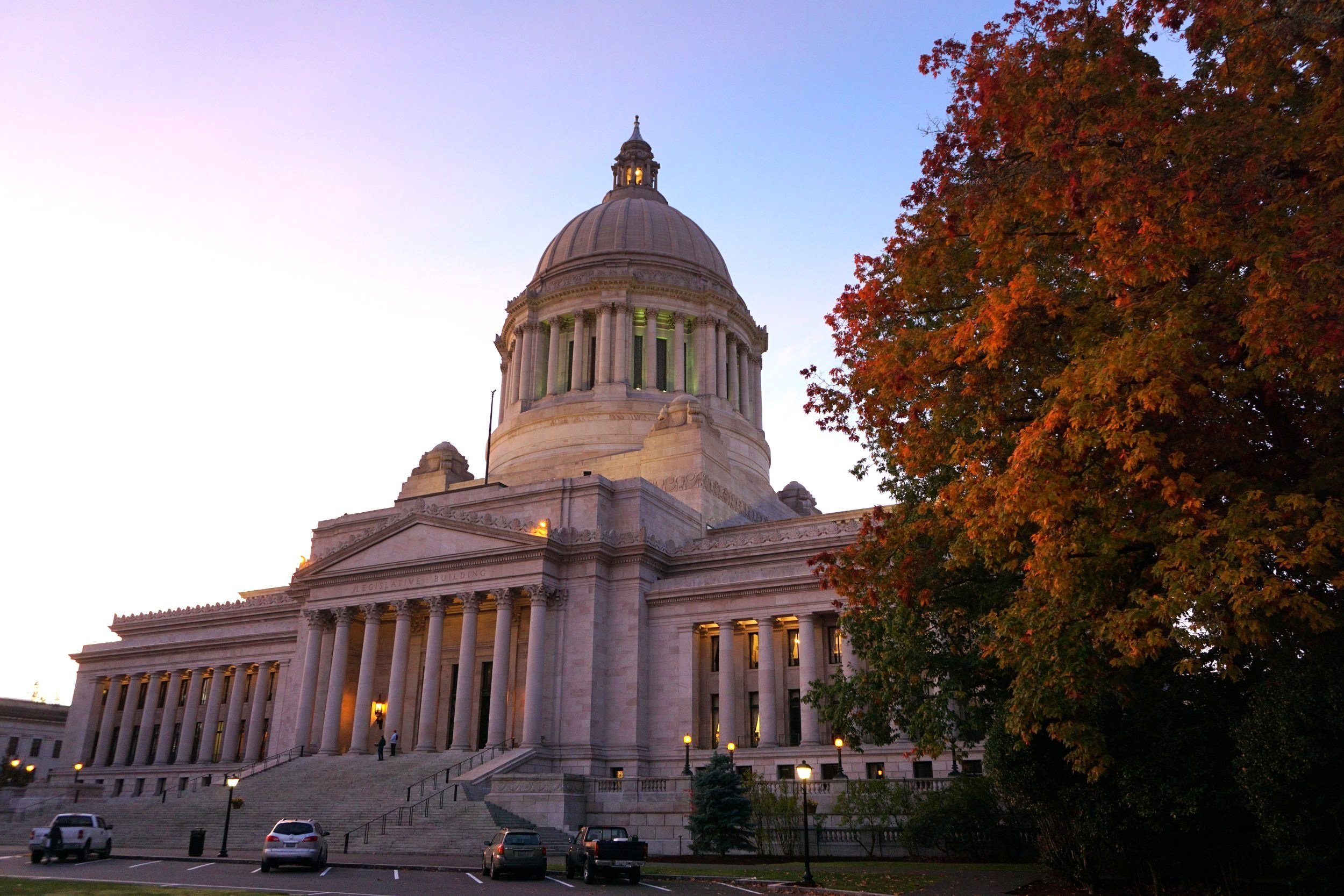
Olympia Watch
2026 Legislative Session
Olympia Watch is WashCOG’s weekly report on what’s happening in the state legislature and your guide to action.
Here’s the 2026 edition of the Washington Coalition for Open Government’s weekly Olympia Watch. We’ll be informing readers each Monday about legislation we’re tracking at the state capitol that could affect government transparency. Please let us know if you learn about transparency-related legislation we are not covering here. Contact info@washcog.org.
Feb. 23-27
The good news: A fair amount of legislation to reduce government transparency in Washington died last week for 2026 because of a legislative deadline for bills to pass either the House or Senate. Thanks for your support and assistance!
The bad news: At least one really harmful and ill-considered piece of legislation, HB 2637, remains alive and is heading to the Senate for review Tuesday. Please go to the Legislature’s District Finder Tool to get contact information for your senator and two House representatives. By email or phone, please ask them to oppose HB 2637.
It’s a sweeping and dangerous piece of legislation that restricts Washington residents’ access to information to “personal information” that has long been available under the Public Records Act. It’s ostensibly aimed at frustrating efforts of the federal Immigration and Customs Enforcement agency.
While WashCOG has no position on federal immigration policy, our coalition from across the political spectrum agrees that this would restrict Washington residents from accessing important information that has long been available under the PRA (which already has numerous more carefully considered PRA exemptions for personal information that is truly in need of protection.) WashCOG’s sister organization in Minnesota tells us ICE used federal databases to target enforcement efforts there, and that there is no indication that ICE used state public-records laws. As a WashCOG representative testified before a legislative committee last week: “This bill would create an unintended and gaping hole in the PRA. ICE is not going after this information via the PRA. Please kill this bill.”
Feb. 16-20, 2026
We’re just barely past the halfway mark for the 2026 legislative session, but already some bills that would compromise government transparency are advancing much further than the Washington Coalition for Open Government would like. There are also a few bills that would make pro-transparency improvements.
We’re asking open government supporters to communicate with your legislators to express your opposition or support for the following bills. Just go to the District Finder and plug in your address to get the phone numbers you’ll need. We recommend leaving a voice mail, but emailing is also helpful. See further instructions below if you’d like to weigh in on bills being heard in two House committees on Wednesday.
For daily updates on WashCOG’s activities and legislation, please see our Facebook page.
Please call about these bills:
Oppose “modernization” of Public Records Act
HB 2661 would set up a task force to report back to the Legislature on how the Public Records Act could be “modernized.” It amounts to an attack on the voter-approved PRA, with language instructing the task force to consider how to end “frivolous, retaliatory or harassing” requests for records, which WashCOG has found to be very much the exception. This bill seems likely to empower government officials to decide what information requests are legitimate and which are not. If you call about just one bill, please make it this one. The message: a hard no. WashCOG is willing to discuss issues around how to make the law work better. But not under the preordained slant of this bill.
Guardrails needed on emergency meetings bill
HB 2520 is ostensibly needed to facilitate meetings of county commissioners when a major emergency prevents the regular order of business, temporarily jettisoning some requirements of the Open Public Meetings Act. The devil in the details here is who decides what constitutes an “emergency,” and how to assure public access to these meetings. Please tell your House members and senator: This bill needs to assure that “emergencies” cannot be lightly declared; that the public needs to be absolutely sure it can access any such emergency meetings; and that any final action taken at such meetings must pertain strictly to the declared emergency.
Personal information bill needs amendment
HB 2637, “Safeguarding personal information entrusted to agencies that is of no legitimate concern to the public,” is dangerous in its current form because office holders and government officials could hide their home addresses and other information. But Rep. Gerry Pollet has come up with an amendment that would make sure this bill doesn’t affect records held by the Public Disclosure Commission, and would not affect property records, and would ensure that the person’s publicly available voter identification would still include the year of the voter’s birth. It’s not ideal but these amendments would improve the bill considerably. Please tell your representatives and senator to insist on these pro-transparency measures.
Tribal health-care PRA exemption is far too broad
WashCOG continues to strongly oppose HB 2685, “Concerning sharing and protection of tribal data,” until a poorly drafted PRA exemption attached to the bill is reversed. It would make all data that tribes convey to a long list of state agencies exempt from the Public Records Act. The bill is supposedly about health-related information, much of which we believe is already covered by existing PRA exemptions. WashCOG testified against this bill, as did the Washington Health Care Authority, which echoed our testimony that the PRA exemption is overly broad.
Sunshine Committee bill stuck in Rules Committee
WashCOG continues to enthusiastically support HB 2244, “Adopting the recommendations of the public records exemptions accountability committee.” These recommendations by the legislatively created “Sunshine Committee” would undo exemptions to the Public Records Act that the committee has found to be outdated, outmoded or ill-advised. Please urge your House representatives to ask that this be pulled from the Rules Committee for consideration by the full House.
Coming up in committee this week:
Maintaining archival state records
SB 5863 “Concerning the preservation and inspection of state historical records,” requires records transferred to the Division of Archives and Records Management to be open to inspection and copying after the expiration of 75 years from creation of the record. It also preserves records related to Lakeland Village, a state-run facility that provides training, education, and healthcare for individuals with intellectual and developmental disabilities. WashCOG supports this bill. This bill comes up Wednesday at 1:30 p.m. in House State Government & Tribal Affairs Committee. Please go here to sign in “pro” on this bill.
Hiding voter information
SB 5892, “Relating to protecting the voter registration database,” restricts county elections officials from turning over data from voter registration rolls to anyone and directs that those inquiries must go to the secretary of state. This seems related to federal Department of Justice efforts to obtain such information from states. This seems like an unnecessary overreaction that could prevent residents of the state from obtaining public information. We oppose this bill and ask that you sign in “con” before the House State Government & Tribal Affairs Committee takes it up on Wednesday at 1:30 p.m.
Keeping special education decisions available to the public
SB 6268, “Maintaining an online record of special education complaint decisions,” requires the Office of the Superintendent of Public Instruction to maintain an online record of all final decisions issued in response to special education community complaints in the prior 20 years. WashCOG is unclear on why these were not previously being maintained. We support this bill, which comes up Wednesday at 10:30 a.m. in the House Education Committee; please go here to sign in “pro” on this bill.
We are still monitoring these bills:
Concern about one-stop state portal PRA exemptions: We are continuing to monitor SB 6164, Concerning individual privacy by WaTech through exemption from public inspection & copying, and HB 2491 Concerning individual privacy by WaTech. Both of these measures seek to facilitate a new online portal to allow residents to interact with numerous state agencies for state benefits, to reserve campgrounds and a host of other purposes. The broadly worded Public Records Act exemption contemplated as part of this bill gives us pause. WashCOG will be looking for an assurance that this exemption will apply only to residents applying for state services online. At the individual agencies where such applications are currently submitted, information on people using the system is granted a PRA exemption.
Feb. 9-13, 2026
We’re not quite halfway through the 12-week legislative session. The first “cutoff deadlines” that leave many bills stranded and dead for the year came and went last week. Of more than 40 pieces of legislation the Washington Coalition for Open Government was tracking a week ago today, about two dozen are still firmly in play. And a few have the potential to do real harm.
Here are the top 10 bills we’re still tracking. We are still learning more about other measures. For daily updates on WashCOG’s activities and legislation, please see our Facebook page.
Bill to “modernize” Public Records Act looks more like an attack
HB 2661 - Establishing the legislative task force on Public Records Act modernization.
When we first heard about this idea, it seemed welcome. Alas, once Rep. Skyler Rude of Walla Walla introduced the legislation, it was readily apparent that this was intended as an attack on citizens seeking information from state and local governments. The whole bill comes from the motivation to limit what must be released. WashCOG opposes this bill.
Emergency meetings bill needs more safeguards
HB 2520 - Concerning emergency meetings of public agencies. This bill is worrisome because it could allow county commissions to meet on the pretext of an “emergency” and take final action without the usual good-government measures required under the Open Public Meetings Act. WashCOG opposes this legislation in its current form and advocates that at minimum, the measure should specify that it applies only to “emergencies” that are formally declared by state or federal officials. And also that any final action taken at such meetings must pertain strictly to the declared emergency.
Concern about one-stop state portal PRA exemptions
We are monitoring SB 6164, Concerning individual privacy by WaTech through exemption from public inspection & copying, and HB 2491 Concerning individual privacy by WaTech. Both of these measures seek to facilitate a new online portal to allow residents to interact with numerous state agencies for state benefits, to reserve campgrounds and a host of other purposes. The broadly worded Public Records Act exemption contemplated as part of this bill gives us pause. WashCOG will be looking for an assurance that this exemption will apply only to residents applying for state services online. At the individual agencies where such applications are currently submitted, information on people using the system is granted a PRA exemption.
Hark! The sound of sunshine!
WashCOG continues to enthusiastically support HB 2244, adopting the recommendations of the public records exemptions accountability committee. These recommendations by the legislatively created “Sunshine Committee” would undo exemptions to the Public Records Act that the committee has found to be outdated, outmoded or ill-advised.
Keeping special education decisions available to the public
SB 6268, Maintaining an online record of special education complaint decisions, requires the Office of the Superintendent of Public Instruction to maintain an online record of all final decisions issued in response to special education community complaints in the prior 20 years. WashCOG is unclear on why these were not previously being maintained. We support this bill.
Maintaining archival state records
SB 5863 Concerning the preservation and inspection of state historical records, it requires records transferred to the Division of Archives and Records Management to be open to inspection and copying after the expiration of 75 years from the record's creation. It also preserves records related to Lakeland Village, a state-run facility that provides training, education, and healthcare for individuals with intellectual and developmental disabilities. WashCOG supports this bill.
Tribal health-care PRA exemption is far too broad
WashCOG is strongly opposing HB 2685, concerning the sharing and protection of tribal data, because of a poorly drafted PRA exemption attached to the bill. It would make all data that tribes convey to a long list of state agencies exempt from the Public Records Act. WashCOG testified against this bill last week. So far, we have not heard a convincing justification for another PRA exemption, especially one with such broad applicability across so many agencies. It’s notable that the Washington Health Care Authority also testified that the PRA exemption is overly broad.
Bill would limit suits against state
WashCOG is opposing SB 6239, which requires arbitration for tort claims against the state of Washington and its subdivisions. This would force anyone who wants to sue the state to first seek to settle the case through arbitration. Arbitration is a private process. Suits against our common government should be litigated in open public court. Numerous abuses in realms such as foster care and abuse inside prisons have come to light because of such suits. These legal actions help alert the public — including, importantly, legislators — when state systems are failing.
Measure would hide personal info
HB 2637 - Safeguarding personal information entrusted to agencies that is of no legitimate concern to the public is a puzzler for us. It would exempt from the Public Records Act virtually all information about individuals. WashCOG opposes this bill based on its loose language that could allow all manner of information to be withheld. Example: “Personal information in files maintained for employees, appointees, or elected officials of any public agency to the extent that disclosure would violate their right to privacy.” What does that mean? It sounds like a statute that would engender a lot of litigation, at minimum. It seems like this may be an anti-ICE bill, but it needs to be thought through much more thoroughly so that ordinary citizens don’t lose access to this information.
Feb. 2-5, 2026
Please sign in ‘con’ on ‘modernization’ bill, ‘pro’ on news funding
With deadlines this week for all bills to pass a committee or die for the year, the coalition is focused on one bill that could do a lot of harm to government transparency, and one that could improve the situation. We’d love for you to help our cause by weighing in with the legislative committees considering these bills. (See instructions below for how to register your support for transparency!)
Bill to “modernize” Public Records Act looks aimed at weakening it instead
When Rep. Skyler Rude told WashCOG that he was filing a bill to create a work group to recommend improvements in the Public Records Act and asked us to participate, we of course agreed. That’s our wheelhouse, after all.
So we were quite disappointed when Rep. Rude’s last-minute bill emerged last week. All we had to do was look at the proposed legislative findings. Particularly the sentence that says the Legislature “finds that misuse of the public records act for frivolous, retaliatory, or harassing purposes strains limited public resources” and causes other problems.
We’re here to tell you that as a nonprofit group that focuses hard on how the Public Records Act is administered, we are still waiting for any evidence that “frivolous, retaliatory or harassing” PRA requests are anything but the extreme minority. Where is the data?
House Bill 2661 also speaks of “legitimate purposes” for filing a request under the PRA. The people of Washington, in voting by a large margin to approve the forerunner of the PRA, did not declare that such requests can be filed only for “legitimate purposes.” Who is to decide what is a “legitimate purpose?” This is a slippery slope to where government decides what’s convenient to release and what is not.
The bill would set up a study group dominated by the kinds of agencies that must respond to PRA requests. Their job: to find ways to “modernize” the PRA and “deter abuse.” Representatives of the people, journalists and lawyers who often file PRA requests would be in the minority. The whole process seems skewed to make obtaining information from state and local governments more difficult.
Considering how this legislation seems aimed at weakening the PRA, we ask you to please sign in “con” on House Bill 2661, which comes before the House State Government & Tribal Affairs Committee. The committee meets at 1:30 p.m. Tuesday, Feb. 3. Typically, comments must be filed at least one hour before the start of the meeting.
Bill to fund local news reporting up for a hearing
WashCOG is all about fighting for government transparency because citizens need to know what their government is doing when they head to the ballot box. It’s a basic tenet of our democracy that government is carried out with the consent of the governed. And the governed must be informed to make smart choices when selecting leaders.
It's for that reason that WashCOG is supporting a bill that would help preserve local news reporting in Washington. Coverage by the news media is a major path for government transparency to translate into an informed electorate. Yet the news media, for reasons related mostly to a business model broken by the dominance of internet companies like Google and Meta, already is faltering and could ultimately go away.
Senate Bill 5400 would raise $20 million a year by taxing internet companies, with the likes of Tik Tok and Microsoft paying no more than $6 million each annually. They can afford that. And consider that they now use news stories to attract readers to their sites, but don’t pay anything to the news companies that produce local journalism.
The money raised would support newsroom jobs around the state. One provision under consideration would funnel $1 million to continue support for a journalism fellowship program run out of Washington State University’s Murrow College of Communication that aims to place a journalist in each of Washington’s 39 counties. It’s do or die for the Murrow program; last year legislators voted to cut off the funding.
SB 5400’s sponsor. Sen. Marco Liias of Snohomish County, told Brier Dudley of The Seattle Times that prospects for the bill aren’t great, “but we’ve got to keep the issue alive and in front of people to keep the momentum going.”
SB 5400 will be heard Thursday, Feb. 4 at 1:30 p.m. by the Senate Ways & Means Committee. Please give the bill a boost by signing in “pro” here. Typically comments must be filed at least one hour before the start of the meeting.
Jan. 26-30, 2026
With less than two weeks before deadlines for bills to pass out of at least one committee or die for 2026, legislators plan this week to take up a huge number of bills. Here are the transparency-related hearings the Washington Coalition for Open Government will be tracking this week:
One House bill and one Senate bill seek to amend the Open Public Meetings Act so that city and county councils and commissions can meet during emergencies without the usual protections ensuring that the public can see the public’s business being done. Those protections involve advance notice to the public, among other provisions. But HB 2520 is dangerous, while SB 6000 has a lot more safeguards. The House bill simply says commissions can meet during emergencies, without defining what “emergency” means. Worse, it allows binding action to be taken. The Senate bill specifies that it is only for emergencies formally declared by state or federal authorities in response to a natural disaster. The Senate bill also forbids taking final action on ordinances or other measures. WashCOG opposes the House bill, which is scheduled for consideration by the House State Government & Tribal Relations Committee on Wednesday. The Senate bill comes up Friday in the Senate State Government, Tribal Affairs & Elections Committee.
Bills in both chambers seek what sounds to WashCOG like sweeping exemptions to the Public Records Act for a one-stop online portal for residents to interact with various state agencies that is being built by Washington Technology Solutions. That’s a state agency that operates the state’s core technology infrastructure. We’re opposed to these bills because while they say they are to protect “individual privacy,” the provisions appear to cover lots of information that could be relevant to a public-records requester, including the names of people who use the system. We are concerned that the word “all” appears repeatedly throughout this bill and indicates expansive exemptions that could conceivably protect just about anything that is entered into a centralized system being created. HB 2491 has a hearing Tuesday before the House State Government & Tribal Relations Committee, while SB 6164 will be considered Friday by the State Government, Tribal Affairs & Elections Committee.
The Public Records Act currently instructs agencies not to release information requested under the act for “commercial purposes.” HB 2391, which is to be considered Tuesday in the House State Government & Tribal Relations Committee, would add “solicitation or fundraising purposes.” It defines solicitation as “the act or an instance of requesting or seeking to obtain something.” That is extremely broad language. It could, for instance, conceivably prohibit a news reporter from using the PRA to get lists of individuals whom the journalist would then seek to interview. The legislation contains an exception for labor unions. WashCOG is opposed to the legislation in its current form and would need to hear additional justifications to move off our position. There is no bill analysis that would further shed light on why this legislation was filed.
HB 2333, nicknamed the “political violence bill” by some, seeks to protect home addresses of office holders and candidates, and a broad array of other government officials. Following the horrific shootings of Minnesota legislators and other incidents involving threats to legislators here in Washington, the motivation for filing this legislation is understandable. The bill summary explains that it would add protections against “threats or harassment of elected officials by providing for increased penalties for the crime of harassment,” and “expands the Address Confidentiality Program to elected officials,” along with additional security measures “to address dangers or threats that would not exist but for the individual's status or duties as an elected official.” It also “prohibits the disclosure of the residential address of elected officials, candidates, criminal justice participants, election officials, and those who reside with any such person, contained in campaign finance reports or records, property records, voter registration rolls, and candidate declarations.” WashCOG does not believe this will be effective, because those who want to attack officials at their homes have lots of ways to find those addresses. The shooter in the Minnesota case, for example, found the addresses through commercially available people finders. WashCOG is remaining neutral on this legislation, which will be heard Tuesday in the State Government & Tribal Relations Committee, but we can foresee the possibility of unintended consequences. The state auditor and county clerks have expressed concerns that the bill is simply not workable in practice.
HB 2356 would make it possible for the next of kin of a murder victim or, in the case of juveniles, the child’s legal guardian, to apply to a court to make the name of the victim exempt from disclosure under the Public Records Act. This sounds like a terrible idea. WashCOG is opposed. The public should know who has fallen victim to murder. Period. This will be heard Wednesday in the House State Government & Tribal Relations Committee.
On Tuesday, the Senate Law & Justice Committee takes up SB 6239, which would force anyone who wants to sue state agencies or local governments to first submit to an arbitration process that is not subject to the Washington Constitution's guarantee of open administration of justice. This would effectively move the process out of the public eye at least in its early stages, and potentially forever in the case of plaintiffs who settle cases without going to an open public court. Think about the kinds of suits that have exposed injustices and bungling bureaucracies, such as those involving people who die in prison and abused foster children. The list goes on. We expect a lot of opposition, but note that it’s backed strongly by lobbies for the city and county governments. WashCOG opposes this measure.
HB1692, “Exempting Certain Data Related to American Indians, Alaskan natives and Indian Tribes From Public Inspection and Copying,” is on the Tuesday agenda of the House State Government & Tribal Relations. The bill summary says it would exempt from the Public Records Act information “prepared, obtained, used, or retained by a local health jurisdiction or a named entity,” creating the impression that this is about health records. But the list of “named entities” is quite long, and the bill does not specify that this is about health information. The bill summary notes that there are already hundreds of exemptions to the PRA. WashCOG is not prepared to support this legislation. Until we learn more about the need for this additional PRA exemption, we are opposed.
SB 6049 would provide a PRA exemption for “all individual survey responses voluntarily provided by state employee, vendor, or contractor in response to a voluntary survey administered by or on behalf of a public agency for the purposes of engagement and improving state government.” The bill will be heard Friday in the Senate State Government, Tribal Affairs & Elections Committee. WashCOG has not yet taken a position on this legislation.
Jan. 19-23, 2026
As the 2026 legislative moves into rapid-fire consideration of legislation in this short even-year session, several bills affecting the Public Records Act are set to be considered by a Senate committee. Here are some bills we expect to be heard this week:
SB 5892, which is scheduled for a public hearing on Tuesday, Jan. 20 and a vote on Friday at the Senate State Government, Tribal Affairs & Elections Committee, would make it a crime for state or local officials to release personal identifying information about voters from the statewide voter election database. The bill, requested by Secretary of State Steve Hobbs, would require all information requests about voter identity to be routed through his office. It directs county elections offices to refer such requests to the Secretary of State’s Office. Republicans have raised concerns that it could make it more difficult for the federal Department of Justice to inquire into the workings of local and state elections. That effort has resulted in the DOJ suing Washington and other states for failing to hand over their voter registration lists. WashCOG has not taken a position on this legislation.
SB 6081 seeks to exempt from the Public Records Act information maintained by the state that would indicate whether a person has transitioned from one sex to another. It’s opposed by the Conservative Ladies of Washington. It has a number of Senate co-sponsors, and the prime sponsor is Senate President Jamie Pedersen. The bill is scheduled for a public hearing in the Senate Committee on State Government, Tribal Affairs & Elections beginning at 1:30 p.m. Tuesday, and a vote in the same committee at its 10:30 a.m. session on Friday. WashCOG has not taken a position on this legislation.
SB 6123, which appears to expand a Public Records Act exemption protecting state employees’ personal information to include employees of local government, will be considered this week by the Senate Committee on State Government, Tribal Affairs & Elections beginning at 10:30 a.m. Friday. WashCOG has not taken a position on this legislation, and we are still seeking to understand its implications and reach.
Jan. 12-16, 2026
As the 2026 session begins, we’ve got a list of 13 bills held over from 2025 and (at last count) 11 bills or emerging bills for 2026. We’ll be keeping you up to date each Monday on what we expect to come up during the week, until the end of the legislative session in March. Here are bills we expect to testify on this week:
● SB 5683 comes up Tuesday at the Senate State Government Committee. It would prevent destruction of important historical records of the treatment of people with disabilities in state institutions. It would make the records public if they’re 75-plus years old, even if they would otherwise be exempt as health/patient records. This continues the work of Stacy Dym, executive director of The Arc of Washington, and Tim Gerlitz, superintendent of Lakeland Village, a state facility for people with intellectual and developmental disabilities. Dym and Gerlitz worked to preserve records at Lakeland Village, which was established in 1914. They were recognized for their work with a Key Award in 2024 for their work in this arena. More details here.
● HB 2333 - On Wednesday, the House State Government & Tribal Affairs Committee takes up what we expect to be controversial legislation proposed to hide the home addresses of legislators in order to better ensure their safety. This comes in the wake of assassinations of state legislators in Minnesota.
● HB 2244 - At the same State Government Committee meeting on Wednesday, HB 2244 will be considered. It would implement at least some of the pro-transparency recommendations of the legislatively appointed Sunshine Committee, which gathered together stakeholders in government and civil society, among others, to ferret out unwarranted exemptions to the Public Records Act.
Please let us know if you learn about transparency-related legislation we are not covering here.